The AI Support Gap: Why Faster Answers Are Not Enough
AI is raising customer expectations for support speed and quality. The teams that win will not just automate replies; they will turn every conversation into a signal for product, CX, and retention.
Customer support is moving through a strange moment.
Executives want AI in production now. Customers expect faster answers now. Support teams are being asked to reduce volume, improve satisfaction, protect retention, and somehow make the whole experience feel more personal at the same time.
That pressure is real. Gartner reported this year that 91% of customer service leaders feel pressure from executive leadership to implement AI. Other CX research points in the same direction: customers increasingly believe AI should make service faster and better, but they have very little patience when the experience fails.
The easy conclusion is that every support team needs more automation.
The better conclusion is narrower: every support team needs better signal capture.
AI can answer more questions. It can summarize conversations. It can route tickets. It can draft replies. But if the organization does not learn from what customers are asking, repeating, escalating, abandoning, and complaining about, support automation becomes a faster way to miss the same problems.
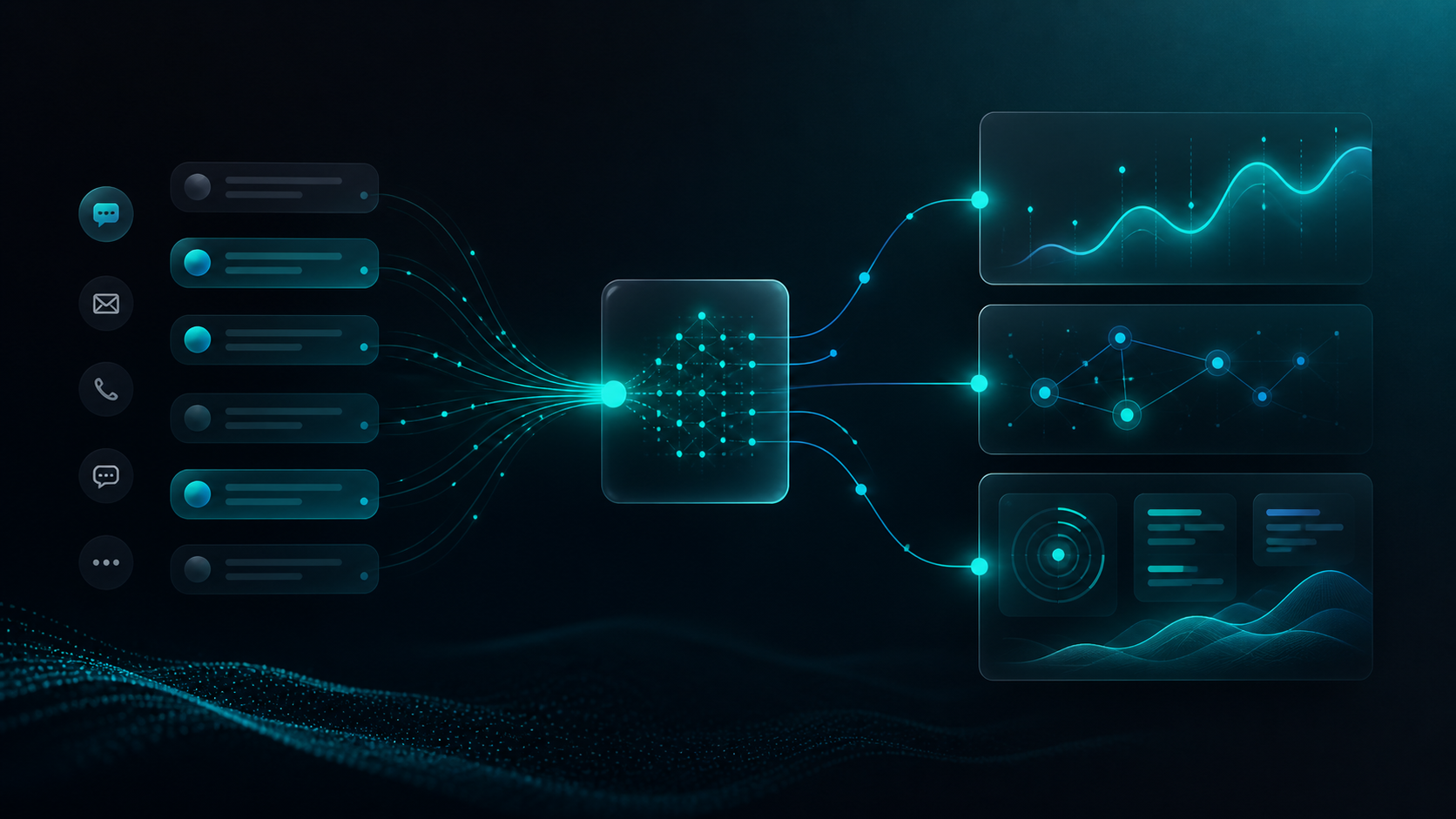
The gap is not between human support and AI support. The gap is between teams that treat conversations as operational exhaust and teams that treat them as a live map of customer reality.
Faster support raises the bar everywhere else
When customers get a fast answer from an AI agent, they do not compare it only to the previous support queue. They compare it to every other instant experience in their life.
That changes the baseline.
A five-minute wait feels longer. A generic answer feels lazier. A handoff that makes the customer repeat everything feels more broken. A product limitation that creates the same ticket every week becomes harder to excuse because everyone can see the volume now.
This is the hidden cost of AI support maturity: once response speed improves, the bottleneck moves.
At first, teams ask:
- How many tickets can we deflect?
- How quickly can we respond?
- How much agent time can we save?
Those questions matter, but they are incomplete. The next questions are more strategic:
- Which issues keep appearing even after automation improves?
- Which customers are accepting the answer but still showing frustration?
- Which product areas are creating the most support dependency?
- Which account segments are getting a worse experience than the average dashboard suggests?
- Which unresolved needs are hiding inside "how do I" questions?
The first set of questions improves support efficiency. The second set improves the business.
Deflection is not the same as resolution
Support teams love deflection because it is easy to measure. A customer opened self-service, did not create a ticket, and the dashboard counts a win.
Sometimes that is true. Sometimes the customer found the answer.
Sometimes they gave up.
AI makes this harder to read. A virtual agent can produce a confident answer that closes the interaction but does not solve the underlying problem. A customer might not reopen the chat. They might not rate the experience. They might simply leave with less trust than before.
That is why deflection without conversation intelligence is risky. It rewards disappearance, not resolution.
The better metric is evidence-backed resolution:
- Did the customer get an answer that matched their intent?
- Did they need to come back for the same issue?
- Did sentiment improve or degrade during the interaction?
- Did the conversation expose a product gap, onboarding gap, documentation gap, or expectation gap?
- Did similar customers run into the same pattern?
You cannot answer those questions from ticket status alone. You need to analyze the language inside the conversation.
The new role of support is pattern detection
AI will keep taking over routine handling. That does not make support less strategic. It makes support more strategic if the team is set up correctly.
The support function is becoming one of the highest-volume research channels in the company. It sees confusion before product does. It sees objections before sales reports them. It sees adoption gaps before customer success can quantify churn risk. It sees workarounds before the roadmap catches up.
Most companies already have the raw material. They just do not have the operating rhythm.
The weekly support review still tends to sound like this:
- Ticket volume is up 8%.
- First response time improved.
- Top categories were billing, onboarding, integrations, and bugs.
- CSAT is stable.
That is useful operational hygiene. It is not enough for an AI-era CX organization.
The review needs to become more specific:
- The billing spike is mostly coming from annual plan customers confused by seat changes after expansion.
- Onboarding friction is concentrated in accounts that imported data from three or more tools.
- Integration complaints are not about setup; they are about missing confidence that syncs are complete.
- The "bug" category contains a recurring product expectation mismatch, not a reliability issue.
- Accounts mentioning delayed internal rollout are also showing weaker renewal language.
That is the difference between reporting categories and surfacing decisions.
Product teams need the raw voice, not just the label
One of the common mistakes in customer feedback programs is compressing conversations too early.
A ticket becomes a tag. A tag becomes a count. A count becomes a slide. By the time product sees it, the customer language is gone.
That worked poorly before AI. It works even worse now.
As support interactions become more automated, product teams need to understand not just what customers asked, but how they framed the problem. The wording matters:
- "I cannot find the setting" means something different from "I am not allowed to change this."
- "Does this integrate with our CRM?" means something different from "Can I trust the data after it syncs?"
- "How do I export this?" means something different from "My leadership team needs a report every Monday."
The label might be the same. The product implication is not.
Good conversation intelligence keeps the chain intact: theme, segment, frequency, trend, sentiment, source conversation, customer quote, and account context. That is what gives product leaders confidence to prioritize from customer reality instead of anecdote volume.
Human agents become the judgment layer
The best case for AI in support is not that humans disappear. It is that humans stop spending their day on repetitive translation work.
AI can identify that a customer is asking about permissions. A skilled agent can notice that the customer is really blocked by internal governance. AI can summarize a frustrated renewal conversation. A customer success manager can decide whether the account needs executive attention. AI can cluster complaints about onboarding. A product leader can decide whether the fix is UX, documentation, implementation, or packaging.
That division of labor only works when the system gives humans enough context to exercise judgment.
If AI hides the evidence, humans become reviewers of summaries.
If AI preserves the evidence, humans become decision-makers.
This is why traceability matters. Every insight should be one click away from the conversations that created it. Every trend should be inspectable by segment. Every recommendation should be grounded in language a customer actually used.
Without that, the organization is not becoming customer-led. It is becoming dashboard-led.
What to build before you scale automation
If your team is under pressure to deploy more AI in support, do not start with a philosophical debate about autonomy. Start with the data layer that will make autonomy safer.
Before scaling automation, make sure you can answer five questions:
1. What are customers repeatedly trying to accomplish?
Not which category they were assigned to. Not which queue handled them. What job were they trying to get done?
This exposes product gaps, onboarding gaps, and expansion opportunities that ticket categories usually hide.
2. Where does automation resolve the symptom but not the cause?
Look for issues where AI answers are accepted but repeat contact remains high. Those are the places where support is treating pain that the product or process keeps recreating.
3. Which segments are having different experiences?
Average support metrics are dangerous. Enterprise customers, new accounts, trial users, admins, end users, and churn-risk accounts often experience the same workflow differently.
Segmentation turns a generic support trend into an operating decision.
4. Which conversations should trigger human review?
Not every conversation needs a human. Some absolutely do.
High-value accounts, renewal risk, angry sentiment, legal or compliance concerns, repeated confusion, and strategic feature requests should all have different review paths than routine how-to questions.
5. How does support learning reach product and success?
Insights that stay inside support do not change the customer experience. The operating model needs a path from conversation pattern to owner, decision, and follow-up.
That might mean a weekly product insight review. It might mean automatic digests by product area. It might mean alerts when strategic accounts repeat a theme. The format matters less than the loop.
The companies that win will learn faster
AI support is quickly becoming table stakes. Customers will expect it. Executives will fund it. Vendors will keep making it easier to deploy.
That means the advantage will move away from basic automation and toward organizational learning.
The winning teams will know:
- What customers are trying to do before they ask for a feature.
- Which support issues are really product issues.
- Which accounts are showing risk before they say they are unhappy.
- Which onboarding gaps are slowing activation.
- Which AI answers are creating confidence and which ones are creating silent frustration.
They will not get there by reading a sample of tickets once a month. They will get there by turning every customer conversation into structured, traceable intelligence.
The future of support is not just faster answers.
It is a company that can hear customers clearly enough to change before the market forces it to.
If you want to see what that looks like on your own support, sales, and success conversations, book a 20-minute demo. We will show you the patterns your customers are already giving you.
Keep reading
AI Customer Service Journey: Why Customers Are Moving Outside Your Support Channels
The AI customer service journey now starts outside company-owned chatbots. Support teams need to understand third-party GenAI behavior, human handoff expectations, and the customer signals that still reach owned channels.
AI Customer Service Metrics: What to Measure Beyond Deflection
AI customer service metrics should prove whether customers get resolved, recover trust, and create useful product signals, not just whether tickets were deflected.