AI Customer Service Metrics: What to Measure Beyond Deflection
AI customer service metrics should prove whether customers get resolved, recover trust, and create useful product signals, not just whether tickets were deflected.
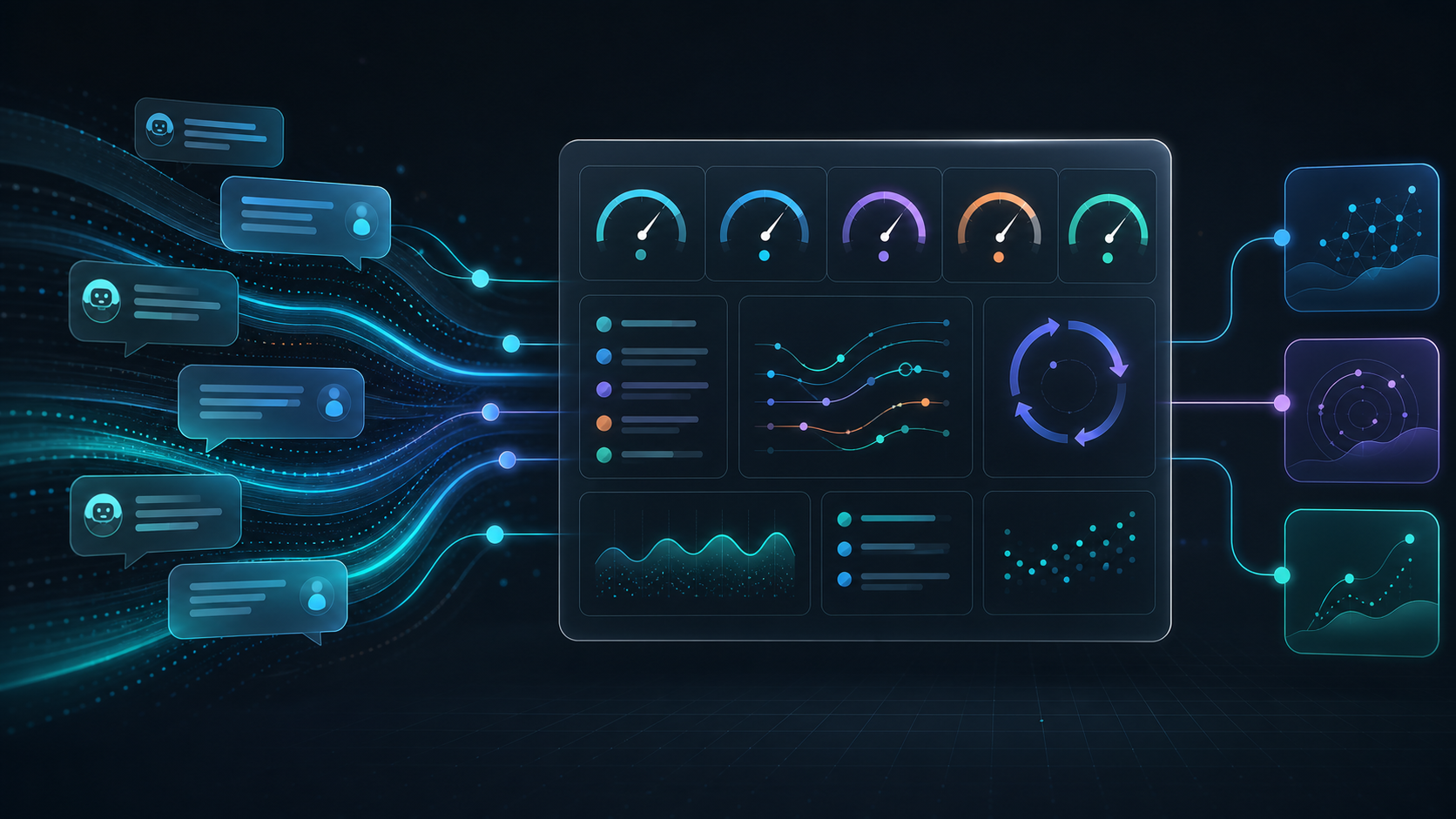
Most AI customer service dashboards start with the same promise: deflect more tickets, reduce cost, and keep the queue under control.
Those metrics matter. But they are not enough.
If an AI agent closes a conversation without solving the customer's problem, deflection becomes a prettier word for abandonment. If the bot escalates late, the human agent inherits an angrier customer with less context. If the same issue returns tomorrow, the dashboard may show automation progress while the customer experience gets worse.
AI customer service metrics should answer a bigger question:
Did the customer actually get helped, and did the company learn something useful from the conversation?
That shift matters because customers are becoming more sensitive to low-quality automation. A 2026 Clutch survey found that poor AI support has already pushed many consumers to consider leaving a business, especially when AI blocks access to a human agent. At the same time, Forrester's 2026 customer feedback management landscape points to a market moving beyond feedback collection toward omnichannel analytics and action.
The opportunity is not just cheaper support.
The opportunity is a better operating system for understanding customer friction.
What are AI customer service metrics?
AI customer service metrics are the measures a company uses to evaluate how AI-powered support affects resolution, customer effort, escalation quality, agent productivity, sentiment, retention risk, and product learning.
The best metrics combine two views:
- Service performance: how well the customer was helped.
- Business learning: what the conversation revealed about product, onboarding, documentation, pricing, policy, or account risk.
That second view is where many teams are still early. They measure whether a ticket stayed away from a human, but not whether the conversation created a signal product, success, or operations can use.
For a B2B SaaS company, that is a costly miss. Support conversations are not only operational work. They are one of the richest sources of voice of customer data in the company.
Why deflection is a weak headline metric
Deflection tells you that a conversation did not reach a human agent.
It does not tell you whether the problem was solved.
That distinction becomes critical with AI. Research published in Management Science on AI assistance in online chats found that AI can improve support efficiency and customer sentiment when used well, but that failed chatbot comprehension can create negative spillover in later human support interactions.
In practical terms, the handoff matters as much as the automation.
A high deflection rate can hide:
- Customers who gave up.
- Customers who returned later with the same issue.
- Customers who escalated through another channel.
- Human agents receiving poor context after failed automation.
- Product issues being repeatedly answered instead of fixed.
- High-value accounts experiencing silent frustration.
Deflection is useful as an efficiency signal. It should not be treated as proof of customer success.
The metrics that matter beyond deflection
A useful AI support scorecard should measure the full journey: first answer, resolution, escalation, recovery, repeat contact, and organizational learning.
1. Resolution-confirmed automation rate
Do not count an automated conversation as successful just because it ended.
Count it as successful when there is evidence the customer resolved the issue.
Evidence can include:
- The customer confirms the answer worked.
- The workflow is completed after the conversation.
- No repeat contact appears for the same issue within a defined window.
- CSAT, sentiment, or customer effort improves after the answer.
This metric protects the team from optimizing for closed conversations instead of solved problems.
2. Repeat contact rate by issue
Repeat contact is one of the fastest ways to detect false resolution.
If customers keep coming back about the same billing confusion, setup error, integration failure, or permissions issue, the AI may be answering the question without removing the root cause.
Track repeat contact by:
- Topic.
- Product area.
- Customer segment.
- Account value.
- Channel.
- AI-only versus AI-to-human journey.
This turns support analytics into product intelligence. It shows which issues are being handled repeatedly and which ones deserve a product, documentation, onboarding, or policy fix.
3. Handoff quality
AI handoff quality measures whether an escalation arrives at the human agent with the context needed to recover the conversation.
A good handoff includes:
- The customer's goal.
- The steps already attempted.
- The likely issue category.
- The account or plan context.
- Relevant product area.
- Sentiment and urgency.
- A concise summary of the conversation.
Bad handoffs force customers to repeat themselves. They also make human agents look less competent, even when the real issue is poor automation design.
AI research is moving in the same direction. A 2026 AAAI paper on customer support conversations focuses on structured support strategies and role-aware conversation quality, which reflects the broader move from answer generation toward better support interaction design.
4. Sentiment recovery
Sentiment at the start of a conversation is useful.
Sentiment movement is more useful.
The question is not only "was the customer frustrated?" It is "did the experience reduce or increase frustration?"
Measure:
- Starting sentiment.
- Sentiment after AI response.
- Sentiment after human handoff.
- Sentiment after resolution.
- Sentiment by issue category.
This helps identify topics where AI is helping, topics where AI should hand off earlier, and topics where the product experience itself is creating repeated frustration.
5. Escalation timing
Not every escalation is bad.
In many cases, a fast escalation is the best customer experience. The mistake is measuring escalation as failure instead of measuring whether escalation happened at the right moment.
Track:
- Escalations after low-confidence answers.
- Escalations after repeated customer clarification.
- Escalations for high-risk accounts.
- Escalations for policy, billing, security, or emotional situations.
- Escalations after negative sentiment shift.
The goal is not to keep humans out of the loop. The goal is to use humans where they create the most trust and value.
6. Knowledge gap rate
Every failed answer should teach the company something.
Knowledge gap rate measures how often AI cannot answer because the answer does not exist, is outdated, is inconsistent across sources, or depends on undocumented product behavior.
This metric should feed:
- Help center updates.
- Support macros.
- Onboarding content.
- Product copy.
- Release notes.
- Internal enablement.
Without this loop, AI support keeps exposing the same content gaps without giving anyone ownership to fix them.
7. Product signal capture
The most strategic AI customer service metric may not be a support metric at all.
It is the percentage of conversations that produce a product, CX, onboarding, or churn signal that is captured, grouped, and routed to the right team.
Examples:
- Repeated confusion about a workflow.
- Feature requests tied to a specific customer segment.
- Friction after a pricing or packaging change.
- Accounts showing renewal risk.
- Gaps between marketing promises and product experience.
- Bugs that appear as "how do I" questions.
Support conversations are usually where product reality shows up first. The metric should not only ask how quickly the support team responded. It should ask whether the company noticed the pattern.
A simple AI support scorecard
For most SaaS teams, a practical scorecard can start with eight metrics:
| Metric | What it tells you |
|---|---|
| Resolution-confirmed automation rate | Whether AI actually solved the issue |
| Repeat contact rate by issue | Whether customers are returning with the same problem |
| Handoff quality | Whether humans receive enough context to recover trust |
| Sentiment recovery | Whether the experience improves or worsens customer emotion |
| Escalation timing | Whether AI hands off at the right moment |
| Knowledge gap rate | Whether support content and internal knowledge are complete |
| Product signal capture | Whether conversations become product and CX learning |
| Account-risk signal rate | Whether support interactions reveal churn risk early |
This scorecard creates a more honest view of AI support performance. It still includes efficiency, but it does not let efficiency dominate the conversation.
How teams should use these metrics
Support leaders should use them to improve automation rules, agent workflows, knowledge coverage, and escalation design.
Product teams should use them to find recurring product friction before it becomes churn, roadmap noise, or lost expansion.
Customer success teams should use them to spot account risk earlier, especially when high-value customers show repeated frustration around the same workflow.
Leadership should use them to separate cost reduction from customer experience improvement.
That separation is important. AI can make a support operation look more efficient while quietly making customers feel less heard. The right metrics make that tradeoff visible before it becomes a retention problem.
The real goal: learning faster from every customer conversation
AI customer service metrics should not stop at "how many tickets did we avoid?"
They should show:
- Which issues are truly resolved.
- Which customers are still struggling.
- Which handoffs need redesign.
- Which knowledge gaps keep resurfacing.
- Which product areas create repeated friction.
- Which accounts need attention before renewal risk becomes visible in revenue.
That is the strategic value of AI in customer support. It is not only automation. It is a way to turn every conversation into a clearer signal about what customers need next.
If your team wants to understand those signals across support, success, sales, and product feedback, book a Synthight demo and see how customer conversations can become product and retention intelligence.
Keep reading
AI Customer Service Journey: Why Customers Are Moving Outside Your Support Channels
The AI customer service journey now starts outside company-owned chatbots. Support teams need to understand third-party GenAI behavior, human handoff expectations, and the customer signals that still reach owned channels.
AI-to-Human Handoffs Are Becoming the New Trust Moment in Customer Experience
As AI agents handle more customer conversations, the handoff to a human is becoming one of the clearest signals of whether your CX operation is actually working.