Voice of Customer Tools: What to Look For Before You Buy
Voice of customer tools should do more than collect feedback. This buyer framework explains how to evaluate VoC software by signal quality, analysis depth, traceability, and action.
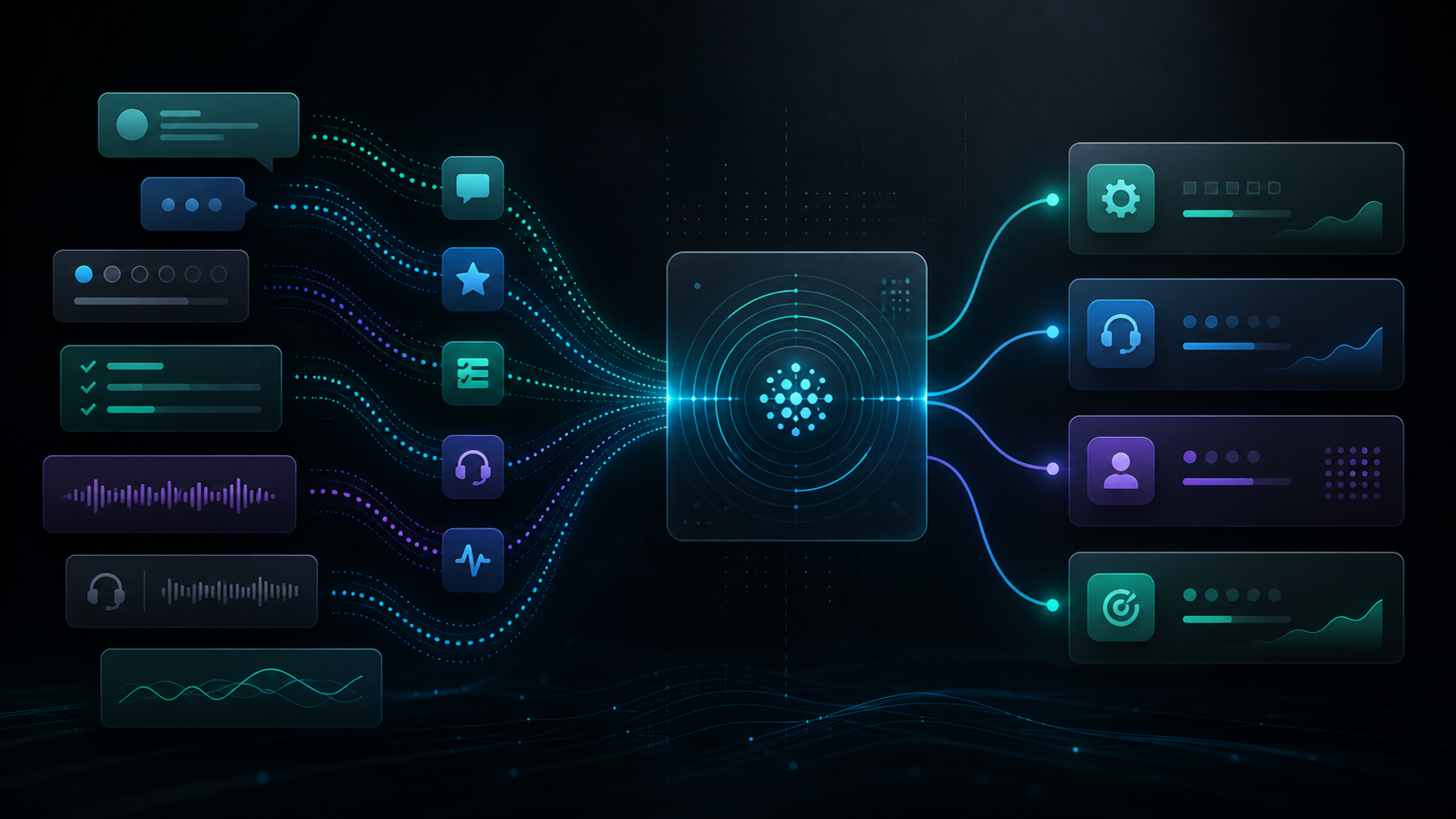
Most teams do not start searching for voice of customer tools because they want another dashboard.
They start searching because customer feedback is scattered.
Support tickets live in one system. Sales calls live somewhere else. NPS comments sit in a survey tool. Product feedback hides in Slack, Gong notes, app reviews, community posts, and spreadsheets. Everyone says they are "customer-led," but nobody can answer basic questions with confidence:
- What are customers repeatedly asking for?
- Which product issues are creating the most pain?
- Which feedback is coming from strategic accounts?
- Which themes are getting worse?
- Which signals are tied to churn, expansion, onboarding, or roadmap decisions?
- Which conversations prove the point?
That is the real job of a voice of customer tool.
Not collecting more feedback. Not making prettier charts. Not sending another survey.
The job is to turn customer language from many channels into evidence-backed decisions.
What are voice of customer tools?
Voice of customer tools are software systems that collect, analyze, and help teams act on customer feedback across channels. Gartner describes VoC platforms as tools that integrate feedback collection, analysis, and action so organizations can understand customer needs, motivations, goals, and behaviors across direct, indirect, and inferred feedback sources.
That definition matters because many teams still think VoC equals surveys.
Surveys are one input. They are not the whole voice of the customer.
Modern VoC programs need to understand:
- Direct feedback: surveys, NPS, CSAT, interviews, in-product forms.
- Indirect feedback: support tickets, chats, calls, reviews, social posts, community threads.
- Inferred feedback: usage patterns, behavioral signals, journey events, operational data.
The best voice of customer tools help you connect those signals instead of forcing every customer insight through one channel.
Why teams search for voice of customer tools in 2026
The search intent behind "voice of customer tools" is usually practical. Buyers are not looking for a theory of customer-centricity. They are trying to fix one of four problems.
1. Feedback is everywhere, but insight is nowhere
Most companies already have enough feedback. The problem is that it is fragmented by function.
Support sees recurring pain. Sales hears objections. Customer success sees adoption risk. Product runs research. Marketing reads review language. Leadership sees a monthly summary.
Each team has a slice. Nobody has the whole picture.
A good VoC tool should unify those signals into a shared customer intelligence layer, not just import them into another reporting surface.
2. Surveys are too shallow
Survey metrics are useful, but they compress the customer experience into a score.
An NPS detractor score tells you something went wrong. It does not tell you what the customer was trying to do, why the workflow failed, how often the issue appears in support, or whether the same theme is blocking expansion in strategic accounts.
The deeper signal often lives in open text and conversations.
That is why AI text analysis, semantic clustering, sentiment detection, and source traceability have become core requirements rather than nice-to-have features.
3. AI support is creating more data than teams can read
Customer service leaders are under pressure to adopt AI. Gartner reported that 91% of customer service and support leaders feel executive pressure to implement AI.
As more AI agents handle frontline support, companies generate more conversation data, more summaries, more handoffs, and more signals about what customers are trying to accomplish.
That only helps if the company can analyze those conversations continuously.
Otherwise, AI makes support faster while the organization keeps learning slowly.
4. Leaders need proof before changing roadmap or process
Customer anecdotes are powerful, but they are not enough for prioritization.
A product leader needs to know whether a theme is isolated or systemic. A CX leader needs to know whether a complaint is concentrated in a customer segment. A success leader needs to know whether repeated language maps to renewal risk.
The right VoC tool should make every insight traceable back to the actual customer conversations, accounts, dates, and segments behind it.
Without traceability, the team debates the summary.
With traceability, the team can decide.
The four capabilities that matter most
Most voice of customer tool comparisons focus on feature checklists. That is understandable, but it can lead buyers toward the wrong decision.
The better evaluation question is: can this tool change what our company notices and acts on?
Start with four capabilities.
1. Signal coverage: can it listen where customers already talk?
A VoC tool should capture the channels that matter to your business.
For a product-led SaaS company, that may include support tickets, chat, in-product feedback, sales calls, cancellation notes, NPS comments, onboarding notes, and product usage signals.
For a support-heavy business, contact center calls and chats may matter more.
For a marketplace or consumer app, reviews and public feedback may be critical.
Do not buy based on the longest integration list. Buy based on the channels where your highest-value customer signals already exist.
Good evaluation questions:
- Which feedback sources can we connect on day one?
- Which sources require manual exports?
- Can the tool handle both structured and unstructured feedback?
- Does it analyze conversations, or only survey responses?
- Can it preserve account, segment, plan, lifecycle stage, and product-area context?
The last question is the one buyers often miss. Feedback without customer context is hard to prioritize.
2. Analysis depth: can it understand meaning, not just keywords?
Basic keyword matching is not enough.
Customers describe the same problem in different language. One customer says "I cannot invite my team." Another says "permissions are blocking rollout." Another says "our admins do not know who owns setup." A keyword system may split those into separate buckets. A useful VoC system should understand the underlying theme.
Look for analysis that can identify:
- Customer intent.
- Product area.
- Pain severity.
- Sentiment and emotion.
- Emerging themes.
- Repeated contact.
- Feature requests vs. bugs vs. expectation gaps.
- Churn or expansion language.
This is where AI can help, but only if the output is grounded.
A generic AI summary is not customer intelligence. Customer intelligence means the system can group, quantify, explain, and prove what customers are saying.
3. Traceability: can every insight be inspected?
Traceability is the trust layer.
If a VoC tool says "onboarding confusion increased 22% among enterprise admins," the next question should be easy to answer: show me the conversations.
You should be able to inspect:
- The source feedback.
- The exact customer language.
- The account and segment.
- The channel.
- The date.
- Similar examples.
- How the theme was classified.
- Whether the theme changed after a fix.
This matters even more as AI becomes part of the analysis. Product, CX, and leadership teams will not trust a black-box insight just because a model generated it.
The tool needs to make evidence visible.
4. Action: can insights move into the operating rhythm?
The "customer voice" is only valuable if it changes decisions.
McKinsey argues that in the agentic era, companies need to move from static customer journeys to dynamic, cross-channel decision orchestration, where context travels and decisions improve across workflows. That shift depends on shared customer signals, not isolated dashboards.
A VoC tool should help insights reach the teams that can act:
- Product gets product-area themes with evidence.
- Support gets repeated issue patterns and knowledge-base gaps.
- Customer success gets account-risk signals.
- Marketing gets customer language that reflects real pain.
- Leadership gets trends tied to business outcomes.
Useful action features include alerts, digests, owner assignment, CRM/helpdesk sync, roadmap handoff, and closed-loop tracking.
But the deeper question is behavioral: will this tool become part of how the team makes decisions every week?
If not, it is just another dashboard.
What not to overvalue when choosing a VoC tool
Some buying criteria look important but do not predict whether the tool will actually improve customer decisions.
Do not overvalue survey design
Survey creation matters if your VoC program is survey-led. But if your richest customer signals live in support, sales, success, and product conversations, survey polish will not solve the core problem.
Do not overvalue volume without depth
Collecting feedback from ten channels is not useful if the tool cannot synthesize meaning across them.
More inputs can create more noise.
Do not overvalue AI summaries
Summaries are useful for speed. They are not enough for trust.
Ask whether the tool can show the underlying evidence, explain why conversations were grouped, and let humans inspect the pattern.
Do not overvalue executive dashboards
Dashboards are helpful after the analysis is right.
They are harmful when they make weak analysis look authoritative.
The buying test: five questions to ask before choosing
Before buying a voice of customer tool, run a practical test with your own data.
Give the tool a real sample:
- 500 support tickets.
- 50 sales or success call transcripts.
- Recent NPS or CSAT comments.
- A few strategic account histories.
- A known product issue your team already understands.
Then ask five questions.
1. Can it find known issues without being told?
If your team already knows onboarding is a problem, the tool should surface the real sub-themes without needing a perfect predefined taxonomy.
2. Can it find issues you did not know about?
The best tools reveal emerging patterns that were not already in your dashboard.
3. Can it segment insights by business relevance?
Volume alone is not priority. A theme affecting five enterprise accounts may matter more than a theme affecting 100 low-value users.
4. Can it show the evidence in one click?
If the tool cannot show the source conversations behind a theme, do not trust it for product prioritization.
5. Can it route the insight to an owner?
A VoC tool should make action easier. If the insight still needs to be copied into a spreadsheet, rewritten into a Slack post, and manually explained to product, the workflow is incomplete.
A simple VoC maturity model
If you are not sure what kind of tool you need, map your current maturity.
Stage 1: Feedback collection
You collect surveys, support notes, and ad hoc feedback. The problem is visibility.
What you need: centralization and basic reporting.
Stage 2: Feedback analysis
You have enough feedback, but the team cannot read or tag it consistently.
What you need: AI-assisted theme detection, sentiment analysis, segmentation, and traceability.
Stage 3: Customer intelligence
You want feedback to influence product, success, support, marketing, and leadership decisions.
What you need: cross-channel synthesis, account context, evidence trails, action routing, and closed-loop tracking.
Stage 4: Decision orchestration
You want customer signals to trigger timely action across workflows.
What you need: a shared signal layer that connects feedback, behavior, account data, and team workflows.
Most teams shopping for "voice of customer tools" think they are in stage 1. Many are actually stuck between stage 2 and stage 3.
That distinction matters because a collection tool will not solve an intelligence problem.
The category shift: from feedback management to customer intelligence
The old VoC category was built around collecting feedback.
The new category is moving toward customer intelligence: a continuous system that reads customer language, connects it to business context, and helps teams decide what to fix, build, explain, or escalate.
That is why the best buying question is not "which voice of customer tool has the most features?"
The better question is:
Can this system help us learn from every customer conversation and act before the same issue shows up again?
If the answer is yes, the tool can become part of how your company runs.
If the answer is no, it will become another place where customer feedback goes to wait.
If you want to see what customer intelligence looks like on your own support, sales, success, and product conversations, book a 20-minute demo. We will show you the themes, evidence, and customer signals your team is already sitting on.
Keep reading
Customer Feedback Management and Analytics: Why AI Raises the Bar
Customer feedback management and analytics is moving beyond surveys and dashboards. AI makes omnichannel customer intelligence, source traceability, and insight activation the new baseline.
Closed-Loop Customer Feedback: How to Turn Insights Into Action
Closed-loop customer feedback is the discipline of turning customer conversations into owned actions, follow-up, and measurable improvement instead of another report nobody uses.