Closed-Loop Customer Feedback: How to Turn Insights Into Action
Closed-loop customer feedback is the discipline of turning customer conversations into owned actions, follow-up, and measurable improvement instead of another report nobody uses.
Most customer feedback programs do not fail because teams collect too little feedback.
They fail because the feedback never closes.
A support conversation gets tagged. A survey comment gets exported. A feature request gets pasted into a spreadsheet. A product manager hears the same theme in three meetings. A customer success manager promises to "share it with the team."
Then nothing visible happens.
The customer does not hear back. The product team does not know which accounts asked. Support does not know whether the root cause changed. Leadership sees a dashboard but not an owner. The same issue appears again next month, now with less trust behind it.
That is an open loop.
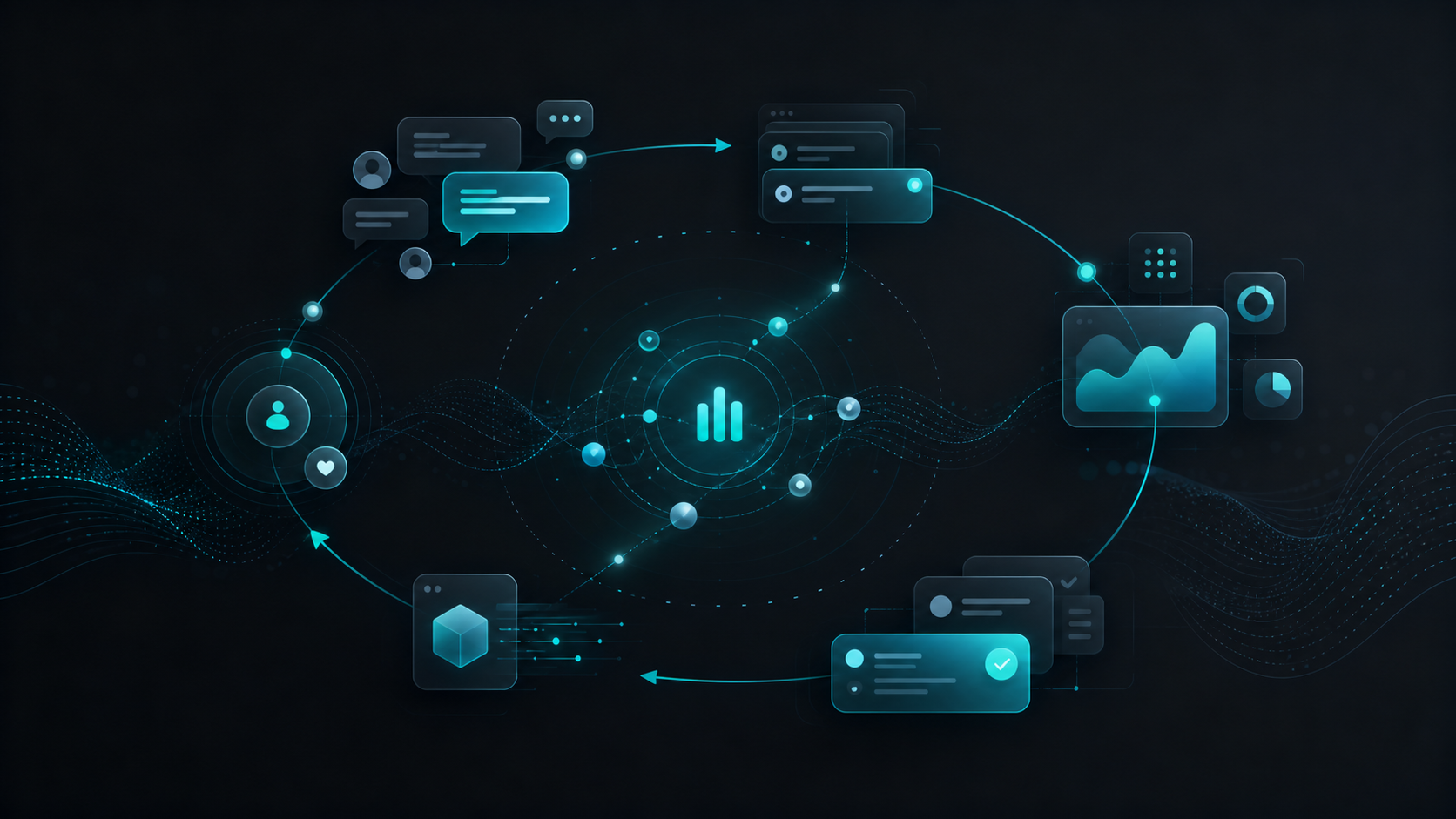
Closed-loop customer feedback means every meaningful customer signal has a path from collection to analysis, ownership, action, customer follow-up, and measurement. The loop is not closed when a theme appears in a dashboard. It is closed when the organization decides what to do, communicates what happened, and learns whether the pattern improved.
For product, CX, support, and success teams, this is becoming one of the most important operating disciplines of the AI era.
What is closed-loop customer feedback?
Closed-loop customer feedback is a repeatable process for handling customer input end to end.
The loop has six parts:
- Capture the customer signal.
- Understand the theme, root cause, and business context.
- Assign an owner.
- Take action or make a decision.
- Follow up with the customer or customer-facing team.
- Measure whether the issue improved.
That is different from customer feedback analysis.
Analysis tells you what customers are saying.
Closed-loop feedback tells you what the company did about it.
This distinction matters because many teams now have better analysis than action. AI can summarize support tickets, cluster survey comments, and detect sentiment across thousands of conversations. But if those insights do not move into product decisions, support fixes, onboarding changes, customer success plays, or customer follow-up, the business impact stays weak.
The bottleneck is no longer only "can we understand the feedback?"
The bottleneck is "can we operationalize what we learned?"
Why closed-loop feedback matters more now
Voice of customer programs have expanded beyond surveys. Gartner describes VoC platforms as systems that integrate feedback collection, analysis, and action across direct, indirect, and inferred feedback sources.
That definition is important. Action is part of the category, not a follow-up task someone remembers later.
At the same time, customer-facing teams are being reshaped by AI. Gartner reported that 91% of customer service and support leaders feel executive pressure to implement AI. More AI in support means more conversations can be summarized, routed, and analyzed. It also means companies can create a dangerous illusion of progress: faster answers, more dashboards, but no better learning loop.
Closed-loop feedback is how teams avoid that trap.
It forces a practical question: what changed because customers said this?
The two loops most teams confuse
There are actually two feedback loops, and both need to close.
The internal loop
The internal loop runs between the customer-facing team and the team that can act.
Support hears the issue. Customer success understands account risk. Product owns the workflow. Operations owns the policy. Marketing owns the promise. Someone needs to decide what the feedback means and what happens next.
If the internal loop does not close, the external loop cannot close either.
A CSM cannot tell a customer what happened with their feedback if product never gave a disposition. Support cannot explain whether a recurring issue is a bug, expected behavior, documentation gap, or roadmap item if nobody owns the answer.
This is why closed-loop feedback is not just a customer communication workflow. It is an internal operating system.
The external loop
The external loop runs back to the customer.
It answers:
- We heard you.
- Here is what we understood.
- Here is what changed, what is planned, or why we are not doing it now.
- Here is what you can do next.
That does not mean every customer gets a custom essay. It does mean meaningful feedback should not disappear.
The external loop builds trust because it proves the company is listening with memory, not just politeness.
Why most feedback loops stay open
Teams usually do not leave loops open because they do not care. They leave them open because the system is weak.
Feedback has no owner
The customer signal is visible, but nobody is accountable for the next step. It is "product feedback" in the abstract, not a task owned by a person or team.
Feedback is grouped too vaguely
"Onboarding issue" is not specific enough to act on. The real theme might be admin permission confusion after data import. If the grouping is too broad, ownership becomes blurry.
Teams cannot trace evidence
If a theme cannot be traced back to the source conversations, product and leadership will hesitate. The insight sounds plausible, but nobody can inspect the proof.
Decisions are not recorded
A team discusses feedback and decides to build, defer, decline, investigate, or fix documentation. But the decision is not connected back to the original customers or accounts.
That makes follow-up almost impossible.
Follow-up is manual
Even when the team ships the fix, nobody has a reliable list of who asked for it. The feedback loop depends on memory, and memory does not scale.
The closed-loop feedback workflow
A useful closed-loop customer feedback system does not need to be complicated. It does need to be explicit.
Step 1: Capture feedback where customers already speak
Start with the channels that contain real customer friction:
- Support tickets and chats.
- Sales and success calls.
- NPS, CSAT, and survey comments.
- Cancellation notes.
- Onboarding notes.
- Product feedback forms.
- Community posts and reviews.
Do not force every signal into a single form. The best feedback often appears in the customer's natural workflow, not in the channel the company prefers.
Step 2: Analyze by meaning, segment, and impact
Closed-loop feedback requires more than tagging.
For every meaningful theme, capture:
- What customers are trying to accomplish.
- The product area or workflow involved.
- The root cause.
- The affected customer segment.
- The account value or strategic relevance.
- Sentiment, urgency, and renewal risk.
- Source conversations and quotes.
This is where AI can help. It can read every conversation, cluster similar themes, detect changes over time, and surface customer language that would otherwise stay buried.
But the analysis must remain inspectable. Teams should be able to move from theme to quote to account to source conversation.
Step 3: Assign the right owner
Every theme should have a likely action path.
Examples:
- Product UX issue.
- Bug investigation.
- Help center gap.
- Support macro update.
- Onboarding workflow change.
- Customer success intervention.
- Billing or policy clarification.
- Roadmap candidate.
- Declined request with explanation.
This is the difference between insight and work. If nobody owns the next step, the feedback is still open.
Step 4: Decide the disposition
Not every piece of feedback should become a feature.
The team needs a disposition:
- Build.
- Fix.
- Investigate.
- Document.
- Defer.
- Decline.
- Escalate.
- Monitor.
The disposition matters because it gives customer-facing teams a real answer. "We are looking into it" is useful only when it is true and time-bound. Otherwise it becomes another way to keep the loop open.
Step 5: Follow up with the customer
Closing the loop does not always mean saying yes.
Sometimes the best answer is:
- We fixed this.
- We shipped a change based on this theme.
- We added clearer guidance.
- We are investigating this with the product team.
- We are not building this right now because it conflicts with the direction of the product.
- We found a workaround for your use case.
Specificity is what builds trust.
A generic "we value your feedback" message does not close the loop. A targeted message that references what the customer actually said does.
Step 6: Measure whether the pattern improved
The final step is measurement.
After the team acts, check whether the issue changed:
- Did ticket volume fall?
- Did repeat contact decrease?
- Did sentiment improve?
- Did onboarding completion improve?
- Did affected accounts recover?
- Did similar requests keep appearing?
- Did customers respond positively to the follow-up?
If the pattern does not improve, the loop is not really closed. The team may have shipped something, but the customer problem remains.
How AI changes closed-loop feedback
AI makes closed-loop feedback more possible and more dangerous.
More possible because AI can analyze large volumes of customer language continuously. It can detect themes, summarize conversations, identify urgency, and connect related signals across support, sales, success, and product channels.
More dangerous because it can make the company feel like the job is done after analysis.
A weekly AI-generated insight digest is useful. It is not a closed loop.
McKinsey argues that companies are moving toward more dynamic, AI-enabled customer experience orchestration in the agentic era. That requires customer context to travel across workflows. Closed-loop feedback is one practical way to make that happen: the signal moves from conversation to insight to owner to decision to follow-up.
The AI layer should help teams answer:
- What is the theme?
- Who is affected?
- Why does it matter?
- Who owns it?
- What happened next?
- Did the customer hear back?
- Did the pattern improve?
If your system cannot answer the last four questions, you do not have a closed loop. You have analysis.
A weekly closed-loop review
The easiest place to start is a weekly review with product, support, success, and CX.
Do not review every piece of feedback. Review the themes that matter.
For each theme, ask:
- What are customers trying to do?
- Which accounts or segments are affected?
- What is the evidence?
- What is the likely root cause?
- Who owns the next step?
- What disposition should customer-facing teams communicate?
- How will we know if the issue improved?
This meeting should produce decisions, not just awareness.
If the same theme appears three weeks in a row without an owner or disposition, the problem is not feedback volume. The problem is operating discipline.
What good looks like
A strong closed-loop feedback system feels quiet and reliable.
Support does not wonder whether product saw the issue. Product does not wonder whether the feedback is real. Success does not wonder what to tell the customer. Leadership does not wonder whether the dashboard reflects actual customer pain.
Everyone can see:
- The theme.
- The source conversations.
- The affected accounts.
- The owner.
- The decision.
- The follow-up status.
- The post-action trend.
That is when feedback stops being a pile of requests and becomes a system for improving the business.
Closing thought
Customers do not expect every request to become a feature.
They do expect their input to matter.
Closed-loop customer feedback is how you prove that it does. It turns customer conversations into memory, ownership, action, and trust.
If you want to see which customer feedback loops are still open across your support, sales, success, and product conversations, book a 20-minute demo. We will show you the themes, owners, and follow-up opportunities hiding in the conversations you already have.
Keep reading
Customer Feedback Management and Analytics: Why AI Raises the Bar
Customer feedback management and analytics is moving beyond surveys and dashboards. AI makes omnichannel customer intelligence, source traceability, and insight activation the new baseline.
Voice of Customer Tools: What to Look For Before You Buy
Voice of customer tools should do more than collect feedback. This buyer framework explains how to evaluate VoC software by signal quality, analysis depth, traceability, and action.